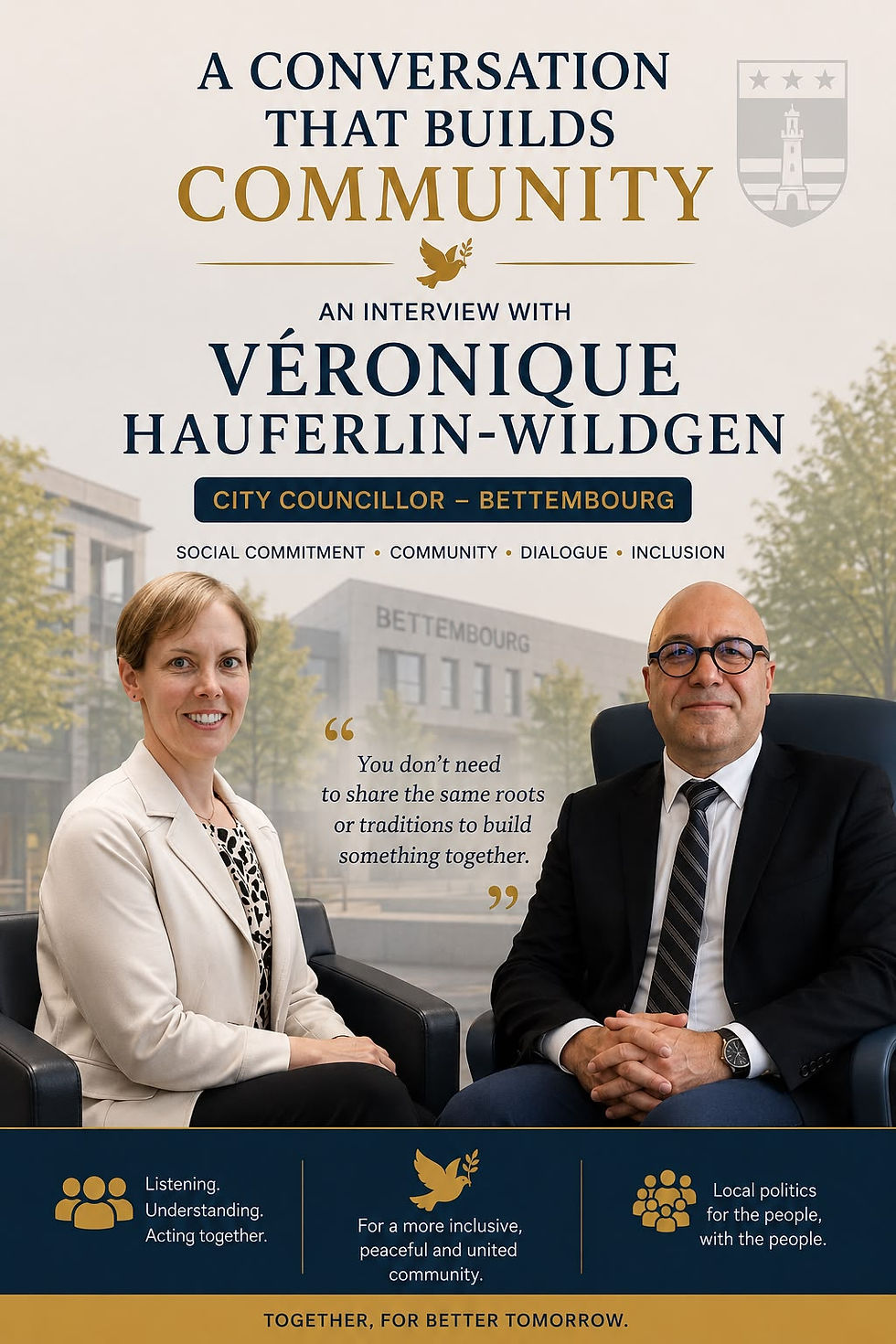
Dialogue Across Cultures: An interview with Véronique Hauferlin-Wildgen
In this interview, Véronique Hauferlin-Wildgen , municipal councillor in Bettembourg and social sector professional, shares her journey, her commitment to serving the community and her vision of living together.
Through her professional, associative and political experience, she addresses in particular the importance of dialogue, trust, integration, cultural diversity and civic engagement.
Q1. Can you briefly introduce yourself and tell us about your professional background and your public involvement?
Véronique Hauferlin-Wildgen:
My name is Véronique Hauferlin-Wildgen, I am married, a mother of two and originally from Fennange. I am the daughter of farmers and I grew up in a rural environment, very attached to village life, associations and traditions, even though I myself have never worked in agriculture.
I am a trained chef and hold a master's certificate in catering. I began my career in the hotel and restaurant industry, then worked in childcare. Today, I work in the social services sector, where I am responsible for everything related to food and beverages.
My involvement in activism began quite early. In my youth, I was active with the Jongbaueren (young farmers), I was president of the Landjugend Süden (Southern Youth League), and also a member of the committee of an NGO. Later, I was also a member of a staff delegation.
Today, I continue this commitment to local political life as a municipal councillor in Bettembourg.
Ultimately, despite very different experiences, I always find the same common thread: human contact, the desire to get involved and to contribute concretely to the community.
Q2. You currently hold positions of responsibility both in the food sector and within a municipal council. What motivated you to dedicate yourself to serving the community?
Véronique Hauferlin-Wildgen:
I think it largely comes from my upbringing and my roots. I grew up in an environment where mutual support, associations and participation in village life were something natural.
So I started getting involved very young, long before I went into politics. Over time, the responsibilities changed, but the motivation remained the same: to participate, to listen to people and to try to make things happen.
I'm someone who prefers to be involved rather than a spectator. And for me, when you accept a responsibility, you also have to be ready to take it on.
Q3. In your opinion, what are the main expectations of citizens towards their local representatives today?
Véronique Hauferlin-Wildgen:
I think that citizens primarily want to be listened to and taken seriously. They want elected officials who are accessible, present in the field, and who understand the realities of their community.
They don't necessarily expect us to solve everything. But they do expect honesty, clear explanations, and for their concerns to be genuinely addressed.
I also think it's important not to make promises you can't keep. Sometimes you have to know when to say no or explain why something isn't possible. That's also part of building a relationship of trust.
Q4. We live in increasingly diverse societies. In your opinion, what are the biggest challenges to promoting living together between people of different origins and cultures?
Véronique Hauferlin-Wildgen:
I am personally very attached to my roots and our traditions. For me, they are part of our identity and it is important to keep them alive and pass them on.
But that doesn't preclude being open to other cultures at all. On the contrary, I find it very enriching to discover other traditions, other festivals, other cuisines, or simply another way of seeing things.
The real challenge, in my opinion, is to prevent different communities from simply living side by side. We need to create opportunities for them to meet, through schools, associations, sports, culture, local festivals, or simply in everyday life.
We don't need to have the same origins or the same traditions to build something together.
Q5. Do you think that dialogue is an essential tool for strengthening social cohesion? Why?
Véronique Hauferlin-Wildgen:
Yes, absolutely. And for me, dialogue becomes particularly important precisely when we don't share the same opinion.
Dialogue does not mean agreeing on everything. It means listening to the other person, trying to understand their point of view, and being able to explain your own respectfully.
My professional experience, my time in a staff delegation and today my political commitment have taught me that good solutions are rarely found without first listening.
And sometimes, simply talking to each other can prevent many misunderstandings.
Q6. In your experience, what are the most important qualities for creating trust between citizens, institutions, and public decision-makers?
Véronique Hauferlin-Wildgen:
For me, it's primarily about listening, honesty, respect, and being close to people. But there's also something very important: being consistent between what you say and what you do.
Trust isn't earned with grand speeches. It's built over time and, above all, through actions. You have to be present, remain accessible, and also know when to admit you've made a mistake.
I prefer an honest answer, even if it is not always the one the person wanted to hear, rather than a promise that cannot be kept.
Q7. Luxembourg welcomes people from all over the world. In your opinion, what is the key to successful integration while preserving cultural diversity?
Véronique Hauferlin-Wildgen:
For me, successful integration works both ways.
A person who comes to live in Luxembourg should not renounce their origins or culture. But integration also means wanting to discover the country they live in, its languages, traditions, how it works, and above all, to participate in society.
For our part, we must also be open to what the people who come to us can bring to us.
I myself am very attached to my traditions, but that doesn't prevent me from being interested in those of others. On the contrary. I think one can be proud of one's roots while being open to the world.
For me, the key is this: respect and openness must go both ways.
Q8. As a woman holding important responsibilities, what advice would you give to younger generations who wish to engage in professional or public life?
Véronique Hauferlin-Wildgen:
I would tell them above all to be daring, to remain curious and to seize opportunities when they arise.
You don't need to know everything before taking on responsibilities. You learn a lot by moving forward, by exchanging ideas with others, and also by sometimes stepping outside your comfort zone.
And particularly to young women, I would say: take your place, but remain true to yourselves. You shouldn't try to conform to an image or a certain way of doing things to be taken seriously.
You can have character, defend your convictions, listen to others and still maintain your own way of doing things.
For me, the important thing is not wanting to prove something, but wanting to contribute something.
Q9. How do you reconcile your professional responsibilities with your commitment to serving the community?
Véronique Hauferlin-Wildgen:
I think it's primarily a question of organization and priorities. My professional life, my family, and my public commitment each occupy an important place in my life.
When I decide to commit to something, I do it out of conviction and with pleasure. Therefore, I don't see it as an additional burden, but as a choice.
You need to be organized, efficient, and sometimes make choices. But when you do things with interest and enthusiasm, you also find the necessary energy.
I like being active, meeting people, exchanging ideas and participating in projects. It's simply part of my personality.
Q10. Finally, what message would you like to convey to those who wish to contribute positively to society, even on a small scale?
Véronique Hauferlin-Wildgen:
I would tell them not to think that you need to have a political mandate or hold an important position to be useful to society.
My own involvement began very early in associations, well before politics.
Helping in an association, giving some of your time, participating in the life of your village or neighborhood, passing on a tradition, welcoming someone new, listening to someone or simply proposing an idea: all of this counts.
Our society functions precisely because of all these people who agree, each in their own way, to give a little of their time and energy to others.
We shouldn't wait until we can change the world. We can start by making a difference in our own lives.


Comments